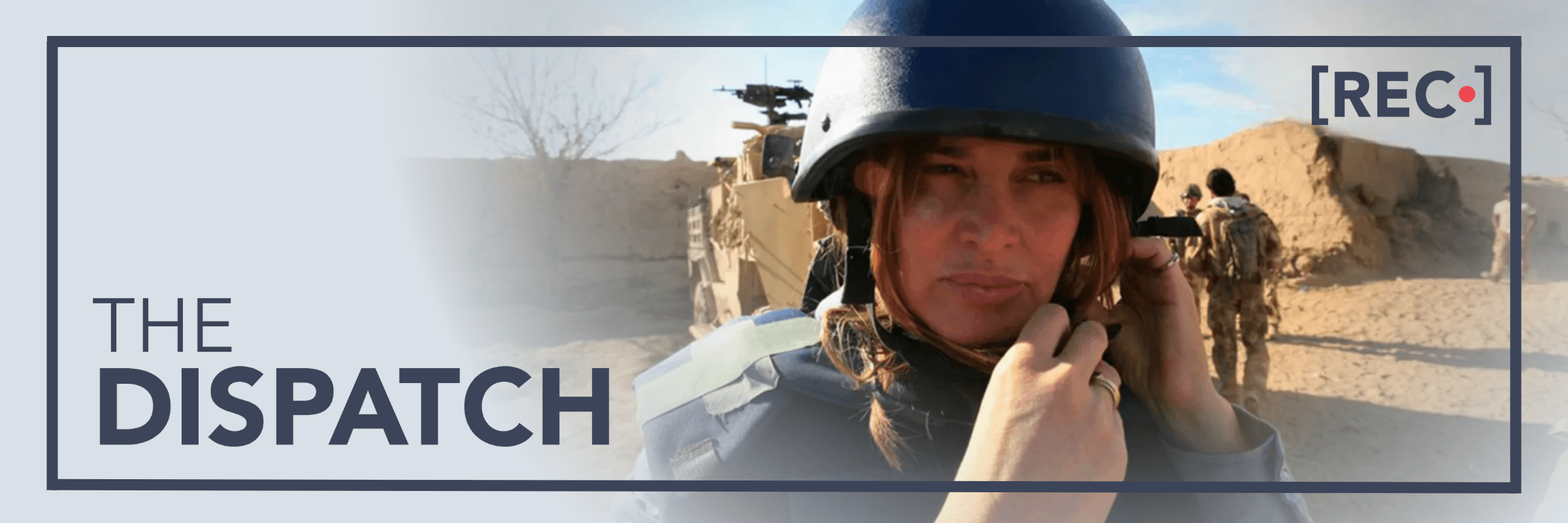
We are introducing The Dispatch, a monthly column from The Reckoning Project
Featuring reflections from members of our team on documenting atrocity crimes in a world where truth is increasingly contested and accountability is under threat.
We are introducing The Dispatch, a monthly column from The Reckoning Project, featuring reflections from members of our team on documenting atrocity crimes in a world where truth is increasingly contested and accountability is under threat.
This first dispatch is written by TRP co-founder and CEO, Janine di Giovanni.
Witnesses to a World Without Rules
By: Janine di Giovanni
Four years ago this month, early on a winter morning, Russian forces invaded Ukraine. The international community responded with disbelief. It should not have. Vladimir Putin had set his sights on a full-scale invasion and major military intervention for months, if not years. Throughout 2021, Russia conducted a large-scale military buildup along Ukraine's borders.
Ukrainians, however, were not shocked. They moved quickly into action.
Within weeks of the invasion, The Reckoning Project (TRP) was founded by Peter Pomerantsev, Nataliya Gumenyuk, and myself. We came from vastly different worlds. Peter is a Kyiv-born British academic, writer, and leading expert on Kremlin disinformation. Nataliya is a courageous Ukrainian journalist, shaped by the 2014 Revolution of Dignity, who led the independent outlet Hromadske from 2015. I had spent decades on front lines—from nearly every major violent conflict since 1990—documenting war crimes and writing books based on witness testimony.
What we shared was a loathing of dictators and bullies, and a fierce commitment to justice.
When Peter first phoned me, I had just completed a United Nations consultancy training Iraqi, Yemeni, and Syrian doctors, activists, and first responders to identify atrocity crimes and take testimony without re-traumatizing survivors. I was also teaching human rights at Yale.
As atrocity crimes in Ukraine escalated and journalists flooded into Kyiv, it became clear that what was missing was a direct, structured link between frontline reporters—who were seeing crimes unfold in real time—and prosecutors. Not only in The Hague, but in Kyiv, in the Office of the Prosecutor General, and in local courts.
We imposed one strict mandate: we would only hire locally as our field researchers. Ukrainians would document crimes committed against Ukrainians. Agency matters. War strips communities of dignity and choice. By training Ukrainian journalists, lawyers, social workers, and activists to become war-crimes investigators, we were not only gathering evidence—we were building capacity.
Four years on, TRP has grown to nearly forty-one staff and operates across three countries. In Ukraine, our work focuses on deportation and forcible transfer, the abduction of Ukrainian children by Russian forces, torture, enforced disappearance, and other grave violations of international law. In 2025, we expanded our work to Darfur and Gaza.
Our methodology has been refined to meet international evidentiary standards and withstand judicial scrutiny. We have secured more than 750 witness testimonies in our archives. This work is about prosecutions—but it is also about memory. What happened in Ukraine—a brutal violation of sovereignty and international law—must not be allowed to happen again.
Four years into the war, an estimated 2 million people are dead on both sides. We mourn that loss of life. We believe that if impunity is halted; future wars will lessen. We believe that without global accountability, there can be no international security.
As we begin 2026, we are living in what Yale legal scholar Oona Hathaway has called a world without rules. The global legal order is under threat. Constraints on the use of force are being openly dismantled. Powerful states no longer feel compelled to justify their actions—whether it is the removal of a sitting president from his own country, or the killing of more than 71,000 people by aerial bombardment in one of the most densely populated places on earth.
TRP exists precisely because of this erosion.
Our team of lawyers, data scientists, journalists and researchers brings decades of experience from Iraq, Syria, Lebanon, Russia, Israel/Palestine, Sierra Leone, Liberia, Somalia, Cambodia, the Balkans, and beyond. We often say: We are watching. We are documenting. And one day, accountability will come.
It is easy to feel despondent in times like these. But living day to day in a world where the rules-based order is being crushed gives us greater urgency, an even greater sense of our mission. Funded by governments and donors including Open Society Foundations, Carnegie Corporation, and Porticus Foundation, we conduct intensive fieldwork, verify evidence, and support prosecutors building cases.
But part of our mission is also to amplify testimony—to explain why this work matters. As Omar El Akkad writes in his searing indictment of Western complicity, One Day, Everyone Will Have Always Been Against This: moral failure is often recognized only in retrospect.
We do not want to forget what we have heard in Bucha, El Fasher, Kherson, Kharkiv, El Geneina, Khan Younis, Shati, and Jabalia. We don't want the voices who were courageous enough to speak to us to be forgotten.
I spent years in Syria under Assad, and later, the ISIS years, quietly listening to survivors of rape and torture. When I returned last year to a Syria free of Bashar al Assad's grip of terror, I encountered a population desperate to speak. They had been silenced for so long under a reign of terror. In the Assad days, I met them secretly, carefully avoiding the secret police. What we do now in many ways is what I did all those years, writing in my notebooks. What happened to you? is the first question we ask.
Then we listen.
The Reckoning Project is now entering an important phase of growth. Please follow our work as we continue to methodically document atrocity crimes and pursue accountability, despite the threats to the very norms that are supposed to protect us as citizens.
I spent a lot of time in Berlin during COVID, one of the most inspiring parts of my day was riding my bike past Zionskirche, the church associated with the theologian and pastor Dietrich Bonhoeffer, who spoke with rare courage against Nazism from inside the machinery of tyranny itself. Sitting quietly in his church, I often reflected on moral courage and authority.
Bonhoeffer exemplified moral courage. He refused to leave Berlin, refused the safety of exile, and joined the Confessing Church in open and rare defiance of Hitler's attempt to subjugate Christianity to the state. He paid for his beliefs with his life—he was executed a few weeks before the war ended. He understood, long before most, that evil advances not only through brutality but through accommodation. "Silence in the face of evil is itself evil," he wrote—not as rhetoric. To me, that means that everyone chooses a side, even with their silence.
This summons painful memories of my years in Sarajevo under siege, Rwanda's genocide, the Yazidi slaughter, of Grozny, of Aleppo, of the wanton destruction of Gaza, and of the cities and villages of Ukraine that have been blackened and burnt by Putin's bombs.
These, too, are terror years that we live in.
And TRP stands firm.
We do not bow.
We exist as witnesses to crimes, as keepers of memory, and as guardians of moral duty.
Media inquiries: info@thereckoningproject.com
Stay Updated
Subscribe to receive the latest news, press releases, and updates from The Reckoning Project directly to your inbox.