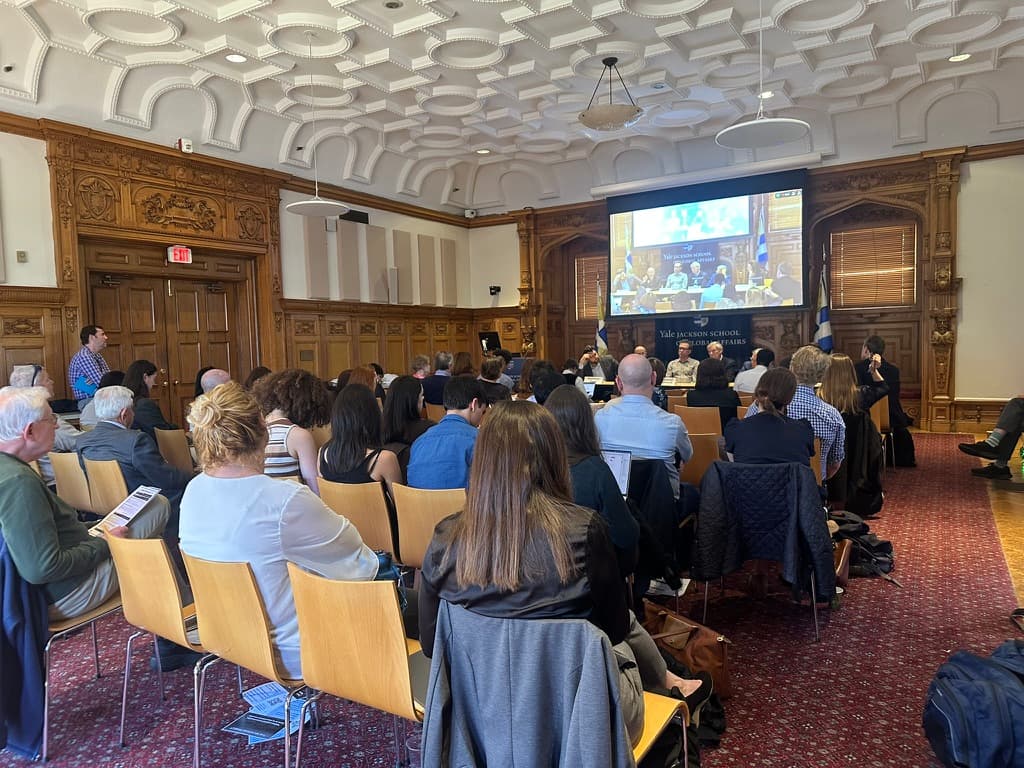
On April 24, The Reckoning Project hosted A World Without Rules at Yale University, a one-day symposium that brought together leading practitioners, academics, and policymakers to examine how the erosion of international norms is reshaping conflict and weakening systems of accountability.
The program opened with brief welcoming remarks from Board Chair David Simon, followed by remarks from CEO Janine di Giovanni, who framed the day around the accelerating breakdown of the rules-based order and the implications for both civilian protection and international justice. She emphasized the urgency of documenting violations as they occur, even as formal accountability mechanisms face increasing political and structural constraints.
The first panel, From Order to Uncertainty: The Collapse of Global Rules, moderated by Janine, featured Azeem Ibrahim, Peter Pomerantsev, Thanassis Cambanis, and Richard A. Wilson. The discussion explored how the steady erosion of international norms, compounded by disinformation and selective enforcement, has contributed to a global environment in which violations of international law are more readily tolerated and less consistently addressed.
The second panel, Accountability in the Age of Impunity, moderated by TRP Chief of Staff Kip Hale, brought together Elizabeth Evenson, John Balouziyeh, and Ambassador Christian Wenaweser. The conversation focused on the constraints facing existing mechanisms, including the International Criminal Court, and examined the expanding role of universal jurisdiction, strategic litigation, and civil society-led documentation in advancing justice where traditional avenues stall.
This was followed by a keynote address from Kenneth Roth, former Executive Director of Human Rights Watch and TRP Board Member, who reflected on decades of efforts to advance accountability through international institutions. Drawing on his experience, he assessed both the progress that has been made and the limitations that persist, particularly in contexts where political will is absent.
The third panel, Lessons of Conflict: What We Got Right and Wrong, moderated by TRP Ukraine Country Director Maksimas Milta, brought together Nataliya Gumenyuk, Jehanne Henry, Tade Akin Aina, and Sarah Leah Whitson. Each speaker offered a focused reflection on what they see as one success and one failure in international responses to conflict. The discussion highlighted recurring gaps between principle and practice, as well as moments where coordinated action, documentation, or sustained advocacy have meaningfully shaped outcomes.
The final discussion, What Comes Next: Rebuilding Norms in a Lawless Age, brought together Robert Malley, Kenneth Roth, Matthew Duss, Jean-Marie Guéhenno, and Nathaniel Raymond, moderated by Janine. This closing expert panel considered what remains possible in an increasingly fragmented system. Speakers emphasized the need for coordinated legal strategies, renewed political will, and sustained investment in documentation and evidence-building as the foundation for rebuilding credibility in international systems.
The symposium concluded with closing remarks from Advisory Board Member Timothy Snyder, who reflected on the historical consequences of abandoning shared rules and the long-term stakes of inaction. He underscored that accountability depends not only on institutions, but on persistence, on those willing to document, preserve evidence, and insist on the record in moments when it is most contested.
Thank you to all who joined us in New Haven and online. A recording of the symposium can be found here.

Opening remarks by CEO Janine di Giovanni

Panel 1: From Order to Uncertainty: The Collapse of Global Rules

Panel 2: Accountability in the Age of Impunity

Keynote address by Kenneth Roth, former Executive Director of Human Rights Watch

Panel 3: Lessons of Conflict: What We Got Right and Wrong

Panel 4: What Comes Next: Rebuilding Norms in a Lawless Age

Closing remarks by Timothy Snyder, Chair in Modern European History at the University of Toronto