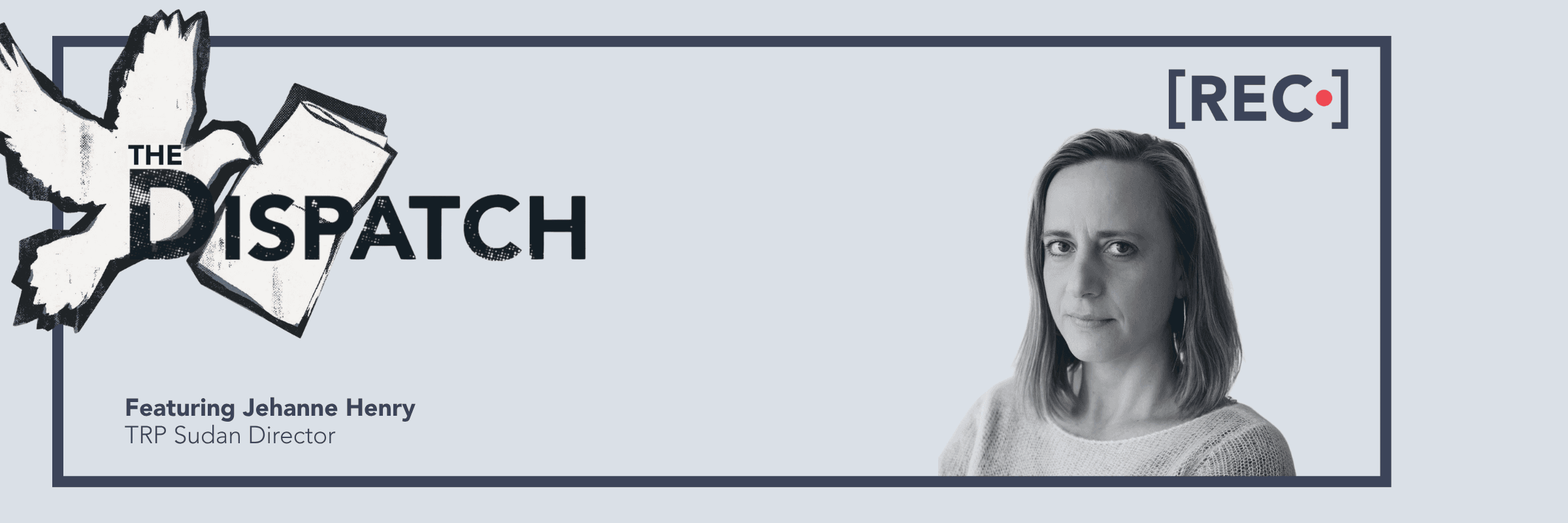
For our May edition of The Dispatch, The Reckoning Project’s monthly column, Sudan Director, Jehanne Henry, reflects on returning to the Sudanese border more than a decade after documenting an earlier conflict, and on the profound toll that cycles of violence, displacement, and impunity continue to exact on Sudan and its people.
Postcard from the Sudanese Border
By: Jehanne Henry
In early April I joined a couple of celebrity journalists, including the founder and CEO of The Reckoning Project, Janine di Giovanni, on a trip to the Sudanese border. We met in South Sudan’s capital, Juba, and flew north along the gleaming White Nile, traversed hundreds of miles of moss-colored wetlands, and landed on a savanna at Yida, a humanitarian hub less than 20 kilometers from the border.
The last time I came to this border, which stretches from Ethiopia to the Central African Republic, was to document the impact of an earlier war. It was more than ten years ago and Sudan’s army was fighting rebels in Southern Kordofan and Blue Nile states, the so-called “two areas” that had become the country’s southernmost region after South Sudan seceded in 2011. One of Sudan’s main tactics was its campaign of indiscriminate bombing of farms, towns and villages, killing scores at a time.
Now I was back at the same border to meet people fleeing from the same region.
The rainy season had come early and refugees were already hitching rides on tractors to cross muddy terrain into South Sudan. We met them at a transit center, waiting to be transported by bus to their new homes in a UN-managed refugee camp. They would have access to better food, medical care, and school for their children, but they were stranded here, alienated from their land and loved ones. Many of those we met had fled because of RSF attacks, deprivation caused by siege, or because of drones that seemed to come out of nowhere and explode without warning, a new feature in Sudan’s wars.
The current war is unprecedented in many ways. It started in the capital Khartoum, essentially a power struggle between the two highest-ranking generals – the head of the army and the head of the RSF – for control of Africa's third largest country and all its resources.
Three years on, the warring sides don’t seem to want to stop and they don’t have to because malign external actors continue to back a side. This includes would-be mediators such as the UAE, which supports the RSF, or Egypt, which supports SAF. Yet the longer the war goes on, the deeper the war’s impact becomes. Beyond the sheer destruction, death, and displacement – now up to 14 million people – the war has split Sudan apart, with the army controlling the east and the paramilitary Rapid Support Forces controlling the west.
When I went to Darfur twenty years ago, much of the damage had already been done, yet fighting and repression persisted and there was no meaningful justice.
It wasn’t the first time I’d lived in a conflict setting. As a law student, I interned at the International Criminal Tribunal for the former Yugoslavia (ICTY). Inspired by the lawyers I met there, I sought field experience and ended up in Kosovo, which was still emerging from violence. I also worked in Cambodia, which still felt decimated decades after Pol Pot. Much earlier, as a child, I lived in Beirut during the Israeli invasion and the massacres at Sabra and Chatila.
I never went back to work in those places, but I do keep coming back to Sudan, trying to make contributions. When people ask, “why Sudan?” I feel like saying, “why not? Isn’t this complex, layered place that contains multitudes sufficient for lives longer than my own?” Then (I can’t help it) I proceed to wax poetic about its vastness and beauty; its diversity; its music, art, and film; its humor and nostalgia.
The new war has changed everything. El Fasher, the capital of North Darfur, where I lived, no longer exists. In October 2025, the RSF ended its 18-month-long siege on the city and took it by force, killing thousands in cold blood, that was famously visible from satellites in outer space. The RSF’s attack forced most of the population to flee, leaving the town empty and full of graves. Khartoum, where I later lived, remains mostly uninhabitable.
But Sudan is so many things besides suffering. It is that unique, relaxed feeling you get when sitting under a tree to drink tea at a stall, or the aroma of fresh bakhoor wafting in the air, or the charm of brightly colored tuk-tuks, or the idealism of revolutionary graffiti that reads "freedom, peace, and justice."
At The Reckoning Project, we aim to contribute to a more just and peaceful future in Sudan. One way is through documenting crimes and preserving evidence for eventual justice. We know that will be a long road. But it isn’t the only way to contribute. We can also preserve memories and reflections, invite participation and help people to keep their hopes and dreams alive.