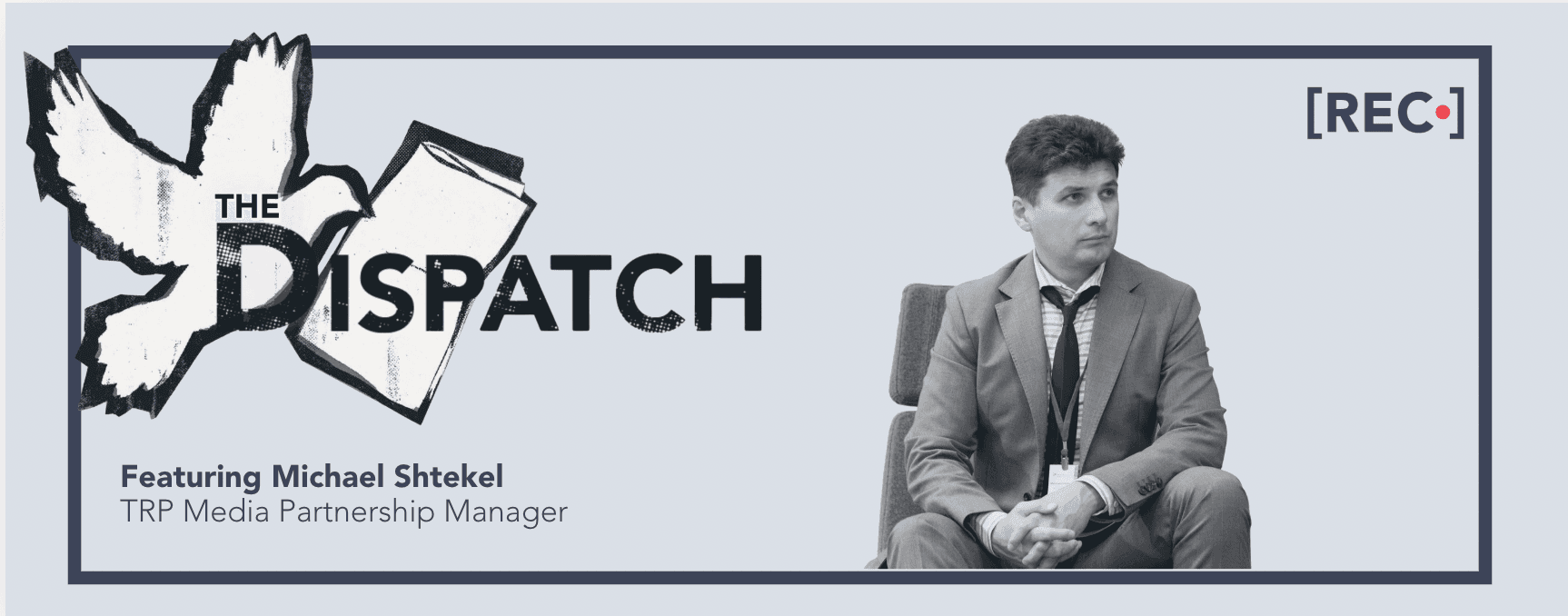
For our October edition of The Dispatch, The Reckoning Project’s monthly column, Michael Shtekel, TRP’s Media Partnerships Manager, reflects on the challenges of communicating war crimes and accountability amid an increasingly crowded news cycle, and how The Reckoning Project uses rigorous journalism and audience-focused storytelling to keep the pursuit of justice at the forefront of public attention.
On Media Politics of The Reckoning Project
When speaking about the media policy of The Reckoning Project, I would begin with the central challenge of our work. We deal with issues that are, by their very nature, long-term: war crimes, their documentation, and investigation, the rights of survivors, and the accountability of those responsible. Yet, we have to communicate these issues at a time when one major news story after another replaces the previous one almost every day.
Today, even the most urgent news about Russia’s invasion has to compete for attention with reports from the war in Iran, coverage of approaching elections in the United States and EU countries, and new humanitarian crises. People’s attention is limited; no one is going to follow the news 24/7. So our task is not simply to remind the world about Ukraine once again. It is to explain why investigating war crimes and crimes against humanity remains important even when a particular war is no longer the leading story.
This is the idea at the core of our media policy. Without documented and verified facts, there can be no proper investigation, and without investigation, accountability becomes much harder to achieve. But documentation has another function as well: it preserves the experience of survivors, creates a public record, and prevents a crime from disappearing into the constant flow of breaking news. For The Reckoning Project, journalism and justice are closely connected. Our methodology combines legal rigour with journalistic storytelling: the information we collect should be valuable both for accountability processes and for the public’s understanding of what happened.
At the same time, we are telling stories about issues that are universal. The right of a child to remain with their family. The right to preserve one’s culture and identity. The suffering of civilians. And the principle that the need to investigate the gravest crimes should not depend on how long they remain on the front page.
But the universality of the issue does not mean that the message itself can be universal. The same story cannot be presented with equal effectiveness to audiences in London, Budapest, Chișinău, Sofia, or Bogotá. Our research shows how strongly perceptions of the war depend on language, sources of information, the political environment, historical experience, and the level of trust in the media.
For example, our research in Moldova revealed significant polarization between different linguistic and information groups. In Hungary, even some people who do not trust government propaganda said that, amid a constant stream of contradictory information, it is becoming increasingly difficult to understand what to believe. In Slovakia, focus group participants described a decline in interest in the war and a shift from actively seeking information to consuming news more passively.
This leads to an important practical conclusion: media policy should not begin only with the question, “What do we want to say?” Equally important are the questions, “Who are we speaking to?” and “Through what frame can this audience understand and engage with the facts?”
Recent TRP publications show how this works in practice. In Colombia’s El Espectador, the story of Olena Yahupova follows a woman who survived unlawful detention, torture, and forced labour and then pursued justice. An important part of the evidence consisted of videos filmed and published by the alleged perpetrators themselves. For the reader, this is not only a story about Russian occupation. It also raises a universal question: how can an individual pursue accountability when the system of violence appears overwhelmingly more powerful than they are?
In our UK project with Byline Times, the point of entry is different. The discussion is built around universal jurisdiction: why a crime committed in one country may, under certain circumstances, be investigated and prosecuted in another. Here, Ukraine becomes part of a much broader international practice of combating impunity rather than an isolated exception.
In Bulgaria, a story about the disappearance of the Bulgarian language and culture from Ukrainian villages under Russian occupation explains the consequences of occupation through the lens of national and cultural identity — something immediately relevant to a Bulgarian audience. In Latvia, a report about lost family photographs speaks about war through the destruction of family memory, through things whose meaning can be understood regardless of a person’s political views.
The facts in all these stories should not change. What changes is the point of entry. Our task is not to adapt the facts to the audience, but to find, for each audience, the language and context in which the meaning of those facts becomes clear.
Today, this is particularly difficult. There are too many important stories, audiences are exhausted by a constant stream of crises, and simply increasing the volume does not solve the problem. Sometimes it is important to tell a human story; sometimes to go deeper into a legal mechanism; and sometimes to focus on culture and memory. At the same time, the facts, evidentiary standards, and respect for survivors must remain unchanged.
The news agenda will inevitably continue to change. That is why the task of our media policy is to remain flexible in form, rigorous about facts, and to use journalism not to deepen divisions, but to bring the conversation back to what is genuinely universal: human dignity, truth, and accountability.